
The Nazis used propaganda to great effect by concentrating on a few key messages and repeating them often.
From 1930, propaganda was controlled in their party by a special department headed by Dr Joseph Goebbels. The department exercised tight control over all aspects of propaganda, especially the press, at national and local levels.
Once they came to power in 1933, the Nazis established a new Ministry of Popular Enlightenment and Propaganda, again headed by Goebbels.
Propaganda and Children
The basic principle of the Nazi propaganda campaigns was to agree a few key themes and slogans and to emphasise them over and over again.
Their appeal to young people was particularly strong and even school textbooks employed propaganda techniques to indoctrinate children with Nazi ideals. The images below are taken from a child’s book. Look at the images carefully then answer the questions that follow.

For Discussion
The Poisonous Mushroom
This is the cover of a book for children. 
The book Der Giftpilz (The Poisonous Mushroom), was published in 1938 for older schoolchildren in Nazi Germany. In the book, a mother explains to her son, Franz, that there are good and bad people in the world. The good people are the good mushrooms. The bad people, the Jews, are the poisonous mushrooms. Read this extract then discuss the points that follow.
‘It is almost noon,’ says the teacher. ‘Now we must summarise what we have learned in this lesson. What did we discuss?’ All the children raise their hands. The teacher calls on Karl Scholz, a little boy on the front bench. ‘We talked about how to recognise a Jew’. ‘Good! Now tell us about it!’ Little Karl takes the pointer, goes to the blackboard and points to the sketches. ‘A Jew is usually recognised by his nose. The Jewish nose is crooked at the end. It looks like a figure 6. So it is called the “Jewish Six”. Many non-Jews have crooked noses too. But their noses are bent, not at the end, but further up. Such a nose is called a hook nose or eagle’s beak. It has nothing to do with a Jewish nose.’ ‘Right!’ says the teacher. ‘But the Jew is recognised not only by his nose…’, the boy continues. ‘The Jew is also recognised by his lips. His lips are usually thick. Often the lower lip hangs down. That is called “sloppy”. And the Jew is also recognised by his eyes. His eyelids are usually thicker and more fleshy than ours. The look of the Jew is sly and sharp…’ Then the teacher goes to the desk and turns over the blackboard, on its back is a verse. The children recite in chorus: From a Jew’s countenance |
For Discussion
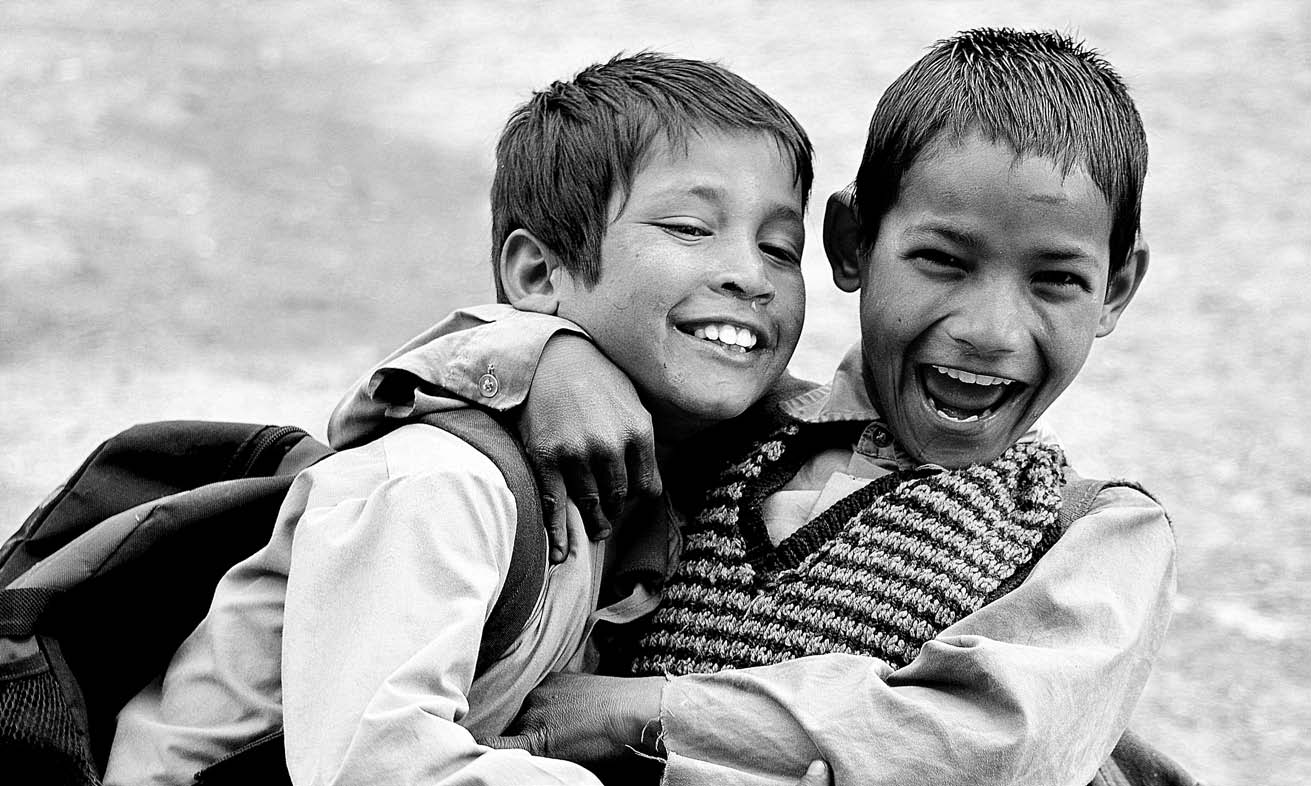
Look at the image below. The text reads: ‘A child’s gaze’

Look again at the same picture as before but this time it has writing over it. The writing says: Grandson of Rabbi Wedell, Dusseldorf.
It emerged that the child in the picture was Jewish. The postcard was then withdrawn from circulation.
The Nazi Propaganda Department issued detailed directives to the National Socialist press to control newspaper reporting of their activities.
In Nazi Germany there was no ‘free press’.
Read this excerpt from a Reich Propaganda Department directive to National Socialist newspapers for the Presidential elections of March 1932 then discuss the question that follows.
| 1. From Easter Tuesday 29 March until Sunday 10 April inclusive, all National Socialist papers, both daily and weekly, must appear in an enlarged edition with a tripled circulation. Two-thirds of this tripled circulation must be made available, without charge, to the Gau leadership responsible for its area of distribution for propaganda purposes… 2. From Easter Tuesday 29 March until Sunday 3 April inclusive, a special topic must be dealt with every day on the first page of all our papers in a big spread. Tuesday 29 March: Hitler as a man. Wednesday 30 March: Hitler as a fighter (gigantic achievements through his willpower, etc.). Friday 1 April: Hitler as a statesman – plenty of photos… |
Look at this antisemitic poster of a Jewish man.

Notice the following symbolism in the poster: